Growth in the present-day digital market is determined by search presence. You could own a business selling local services or handle the global eCommerce processes. Either way, a powerful SEO strategy will determine how your business is found and when.
However, as algorithms develop faster than ever, businesses have one major question: “Should they outsource SEO services or create an in-house SEO team?”
Most business executives believe that it is more controlling to handle everything in-house. However, the reality often proves different. Maintaining technical specialists and link-building expertise requires time and training. Similarly, continuous reporting mandates relevant tools. As a result, internal resources take the strain.
As per Ahrefs, over 96.55% of web pages get zero organic traffic from Google. The reason: They lack proper optimisation. This clearly highlights the need for specialised SEO execution. That means relying on part-time efforts or outdated technical SEO expertise is no longer feasible. Instead, outsource SEO. Here is how outsourcing can prove useful.
1- What does it mean to outsource SEO?

The idea behind outsourcing SEO is seeking external assistance to handle your brand’s digital marketing needs. For instance, you partner with professionals who improve searching visibility and conversions. These experts belong to white-label SEO agencies or SEO consulting firms.
Outsourcing includes a wide range of activities. These range from keyword research to technical audits, content creation and link acquisition. Choosing to hire an SEO agency means gaining access to an entire ecosystem of strategists, analysts and writers. That, too, without actually employing them full-time.
If you run a marketing agency, white-label SEO can work as a strategic solution. For instance, you will get to deliver complete optimisation packages to your clients, under your brand name. The best part: you wouldn’t require expanding infrastructure or hiring new talents to do so. The white-label SEO provider handles execution in the background.
In short, outsourcing means paying for outcomes, not overhead. You gain a chance to connect with seasoned professionals who already understand ranking algorithms and content signals.
2- What are the advantages of outsourcing SEO?

Delegating tasks is one aspect of outsourcing. It also accelerates results through specialisation and experience. Here is how you benefit.
2.1- Access to advanced technical expertise
Search optimisation has gone way beyond placement of keywords. It now encompasses structured data, site speed, crawl effectiveness, and advanced analytics. Outsourcing puts you in contact with someone who has years of technical SEO experience. Such experts would help guarantee your site meets all the current ranking criteria.
Enterprise-level tools, like Ahrefs, Moz Pro, or Screaming Frog, are also accessible to external SEO agencies. Such tools often come with a huge price tag. And not all small agencies are capable of affording them.
2.2- Faster execution and scalable output
Experienced SEO firms already have defined workflows for keyword research and competitor analysis. This means your campaigns are launched quickly. They get scaled easily with evolving goals.
Suppose you need to expand into new markets or target multiple languages. Outsourcing allows instant access to specialists. They handle it all without delay.
2.3- Cost efficiency
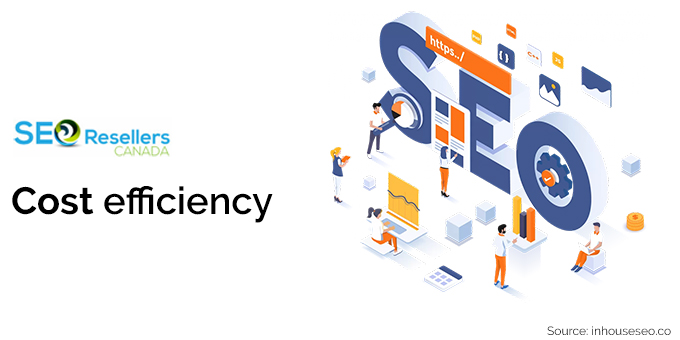
Recruiting, training and retaining an in-house SEO team means worrying about salaries, benefits and even software costs. Comparatively, outsourcing transforms such costs to flexible service charges. You are able to scale up and down depending on your business requirement. This minimises risk and allows you to control your marketing budget and generate 3x higher ROI.
2.4- Algorithm awareness
Search algorithms are updated thousands of times every year; 3200, to be precise. Outsourcing SEO allows you to work with experts who monitor every update. Accordingly, they adjust all strategies for effective rankings.
Such proactive management supports visibility over time.
2.5- Scalability for agencies

In the case of digital agencies, unlimited scalability is possible by outsourcing through white-label SEO providers. Agencies do not need to recruit more talents to take in new clients. Instead, they can let the service provider handle fulfilment without a loss of brand identity.
3- What are the limitations of an in-house SEO team?
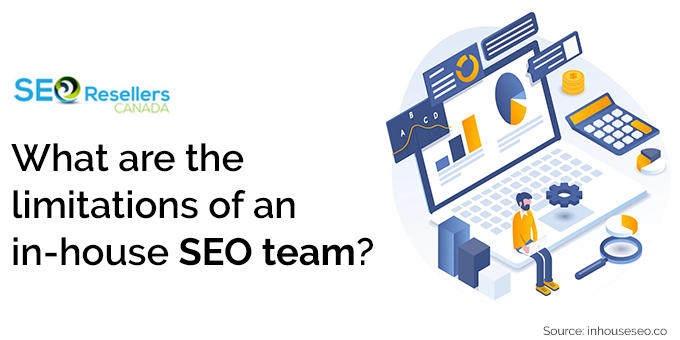
With an in-house SEO team, you definitely gain direct communication benefits. Also, they are highly familiar with the brand. However, there are certain limitations, such as:
3.1- Narrow expertise
An in-house SEO team may handle content, reporting, and site maintenance. However, to achieve real optimisation, several disciplines will be needed. These include technical auditing, outreach, analytics, and strategy. Most companies can’t afford to hire separate experts for every function. And this leads to skill gaps.
3.2- High overhead costs
Keeping full-time employees in specialised positions becomes costly. Similarly, subscriptions for SEO platforms, reporting tools or keyword databases add recurring costs. All of these can be naturally avoided by choosing to outsource SEO services. This saved expense often outweighs the benefit of control.
3.3- Restricted network for backlinks
Professional agencies are good at achieving quality backlinks. That’s because they already have existing relationships with publishers. The internal team does not have that reach, and therefore the process of acquiring links is slow and less effective.
3.4- Burnout risk

Without constant learning, SEO performance drops. Outsourcing subjects brands to continuous innovation, whereas internal teams may find it difficult to adapt to search engine demands.
4- How does SEO outsourcing improve long-term results?

Outsourcing offers value that surpasses instant rankings. It establishes a base for long-term and steady growth.
4.1- Data-driven strategy
Outsourced professionals use data collected by Google Search Console, Ahrefs and other sources to determine what actually triggers traffic. All the decisions, including the selection of keywords and the placement of links, are informed by quantifiable performance measures.
4.2- Strategic depth and consistency

An independent SEO firm applies systematic SEO consultative models that contain audits, keyword mapping, content calendars and performance tracking. This framework guarantees uniformity, even when the campaign evolves or the team members switch.
4.3- Stronger backlink profiles
Google still considers link-building as one of its top-ranking factors. External partners with established link-building strategy systems secure placements on high-authority domains. This, in turn, improves credibility and trustworthiness faster.
4.4- Better adaptability and performance
An external SEO company integrates advanced reporting dashboards. This makes performance and tracking transparent. Brands are able to monitor ranking trends and conversions. They get to see the performance of keywords in real time. This makes it easier to streamline campaigns without losing momentum.
5- SEO agency vs consultant: Which one fits the outsourcing model better?
In the debate of SEO agency vs consultant, opt for one based on your goals and internal capacity.
5.1- When to choose an agency?

A full-service agency is a viable option in situations where the business is in need of a comprehensive implementation. Strategic planning and on-page optimisation are taken care of by agencies. They also combine outreach and content marketing strategies in the same workflow. The majority of your digital marketing concerns are managed by agencies. In addition, they combine SEO with paid and organic strategies to achieve combined performance.
Agencies also bring teams of specialists who collaborate across disciplines. This group experience leads to greater efficiency and uniformity than individual departmental operations.
5.2- When to choose an SEO consultant

A consultant matches firms that already possess partial in-house resources. Consultants design frameworks and audit websites. They also coach your teams on execution. They are more concerned with strategy and alignment than actual management.
Both models offer value. However, agencies typically deliver faster and more scalable results. If you own a digital agency that serves multiple clients, partner with a white-label SEO company. They combine the best of both worlds: strategic oversight and operational fulfilment.
6- Ending note
Search marketing is no longer rewarding isolated efforts. It, instead, is rewarding precision, collaboration and continuous learning. Of course, you will gain consistency with an in-house SEO team. But they may lack speed and advanced knowledge.
With outsourced SEO, you gain access to expert analysts and creative strategies. You also gain access to link-building professionals who remain ahead of algorithm changes. And regardless of the choice you make, whether SEO agency or SEO consultant, you get to focus on growth while specialists handle optimisation for your brand.
7- FAQs
7.1- Is outsourcing cost-effective for small businesses?
Yes. Outsourcing enables the small businesses to avail high-quality SEO services without recruiting full-time workers. They spend only on what is required and capitalise on professional tools and expertise that would otherwise be very expensive in-house.
7.2- What are the risks of outsourcing SEO services?
The primary danger is selecting an unverified provider. Partner only with reputable SEO agencies or white-label SEO providers. See if they demonstrate transparency and clear reporting. They must focus on ethical practices to avoid performance or compliance issues.
7.3- How does outsourcing affect control over SEO campaigns?
Outsourcing improves control when managed appropriately. For instance, reputable agencies deliver detailed analytics. They also maintain regular communication. In fact, they align every decision with the client’s objectives and long-term SEO strategy.
7.4- Can an agency use white-label SEO providers without clients knowing?
Yes. White-label SEO providers work completely under the agency’s brand name. They handle implementations and fulfilments of the clients behind the scenes. Even monthly reports are branded under the client’s name. This means the entire partnership remains confidential and between the agency and the provider.