A lot of small business owners believe they need a big budget to compete online. This belief alone costs them customers every single day. According to BrightLocal’s Local Consumer Review Survey, 97% of consumers read online reviews before choosing a local business, and most research their options online before contacting one directly. If your business does not show up during this search, the call goes to someone else.
This is where a well-chosen mix of digital marketing services starts to matter. The goal is not to outspend your larger competitors. It is to be strategic and make sure your business shows up in front of the right people at the right moment.
This guide explores what actually works for small and mid-sized businesses looking for digital marketing services Canada-wide, covering everything from local search visibility and content strategy to social media marketing.
1- Why Canadian Businesses Need a Structured Digital Marketing Approach
The Canadian market is crowded, and customer attention is not cheap. Whether you operate a dental clinic in Mississauga or a jewellery store in Vancouver, your customers are already comparing options online before they decide to visit. Posting occasionally on Instagram or leaving your website to rank on its own rarely gets you very far.
What tends to work instead is a clear plan built around channels your business can actually execute consistently. A focused approach of online marketing Canada that ties your budget to measurable outcomes like search visibility, qualified leads and repeat customers will generally overpower scattered effort, even on a modest monthly spend. In short, the structure matters more than the size of the investment.
1.1- The Core Components of a Working Strategy
Strong campaigns are rarely built on a single channel doing all the work. The businesses that grow steadily tend to have a few things working together: solid search visibility, content that answers real customer questions, an accurate and active local presence, consistent social engagement, and regular measurement to know what is and is not working.
Focused on separately, none of these pillars do much on their own. For instance, a blog post with no SEO structure will not rank. A Google Business Profile without reviews will not convert browsers into callers. These components need to move in the same direction.
2- SEO Services: The Foundation of Long-Term Growth

Search engine optimization is still one of the most cost-effective ways to attract customers, because it targets people who are already looking for what you sell. Industry data consistently points to organic search as the source of roughly half of all trackable website traffic. Now this is more than paid ads and social combined in most sectors. As such, SEO services act as an asset that keeps working overtime, rather than an expense that disappears the moment you stop paying.
2.1- What Good SEO Actually Involves
Effective SEO is not about stuffing keywords into a page and waiting. A capable SEO company works on a handful of fundamentals, done reliably over time: keyword research grounded in real customer intent, clean page structure with clear title tags and readable subheadings, solid technical health so pages load quickly and crawl without issues, creating content that genuinely matches what someone is searching for and steady link-building from credible sources.
A good SEO agency treats this as ongoing work, not a one-time project. Algorithms shift; competitors publish new content and customer behaviour changes. Consistency wins here, not bursts of activity.
2.2- Local SEO Services for Community-Based Businesses
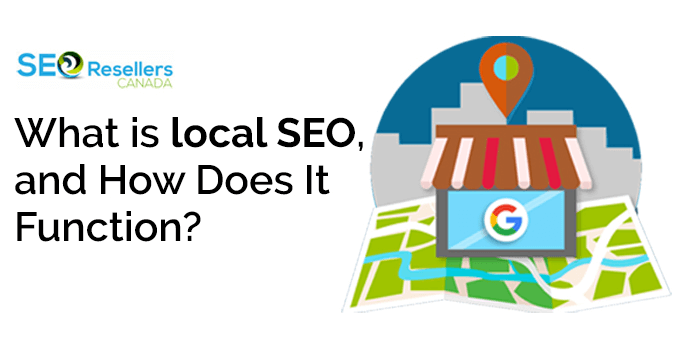
If your business serves a specific city or region, broader SEO alone is not enough. Local SEO services are about making sure your business surfaces when someone nearby searches for what you offer, whether that is “orthodontist near me” or “jewellery repair Toronto.”
This typically means
- Claiming and fully optimising your Google Business Profile.
- Keeping your hours, photos, and service details up-to-date.
- Maintaining consistent business listings across directories like Bing Places and industry-specific sites.
- Actively collecting reviews from satisfied customers and weaving location-specific language into your website copy.
Local SEO often delivers faster, more visible results than national campaigns because the competition for a specific city or neighbourhood is usually far smaller than the competition for a broad keyword.
3- Content Marketing Services That Actually Convert
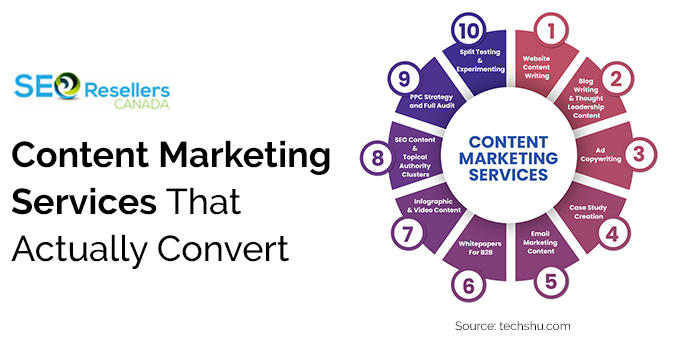
Content is often treated as an afterthought, something to fill a blog because the marketing checklist says so. This approach wastes time and budget. Providers of strong content marketing services treat each piece of content as a long-term asset, something that keeps attracting and converting customers well after it is published.
4- Building Content That Compounds
The most practical approach is to build one strong piece of content and stretch its value across multiple formats.
- Write a detailed post that answers a specific question your customers actually ask.
- Pull the main points into two or three social media posts.
- Summarise it into a short section for your email newsletter.
- Turn a key takeaway into a simple checklist or graphic people can save and share.
This keeps production manageable while making sure your message reaches customers wherever they spend their time online. Over several months, a library of well-targeted content becomes a real competitive advantage, given your older posts keep drawing search traffic without any additional spend.
5- Matching Content to the Buyer Journey
Not every piece of content should push toward a sale. Early-stage content should educate and build trust with people who are just starting to explore options. Later-stage content such as service pages, comparison guides and case studies should make the decision easier for someone who is ready to act.
Balancing both keeps your content marketing from feeling too promotional, which tends to perform better with both readers and search engines.
6- Social Media Marketing: Community Before Conversion

Social media works best when it is treated as a relationship-building tool, not a direct sales channel. People do not follow a business account hoping for a stream of promotions. They follow accounts that consistently give them something useful, entertaining, or genuinely worth their time.
For most small businesses, a straightforward approach works well: pick one primary platform where your audience is actually active and one supporting platform. Settle on two or three content themes you can keep up with long term. Respond to comments regularly, even briefly. Invite customers to share their own experiences. And when it comes to boosting posts, wait until something shows organic traction before putting money behind it. It is because promoting untested content rarely pays off.
Volume matters less than consistency here. A business posting three times a week with real engagement will typically outperform one posting daily with none.
7- Choosing the Right Digital Marketing Agency Canada Businesses Can Trust
Not every agency delivers the same results, and the gap tends to show up a few months in. When evaluating a digital marketing agency Canada-based businesses can rely on, look past the pitch deck, and pay attention to a few practical things.
What to Look For
- Transparent reporting that clearly shows what was done and what it produced.
- Genuine experience in your specific industry. For instance, a healthcare business has different needs than an e-commerce brand, and a good agency should know the difference.
- Realistic timelines because SEO and content take months to show their full effect.
- Clear, regular communication rather than a dashboard you are left to interpret on your own.
Businesses that concentrate their limited resources on two or three well-chosen channels, rather than spreading thin across every available platform, consistently see stronger and more sustainable results. This holds whether you are managing marketing in-house or working with an outside agency.
7.1- Budget Considerations
Most small businesses spend somewhere between 7 and 10 percent of gross revenue on marketing, adjusted by growth stage and how competitive their sector is. The specific percentage matters less than applying it consistently. A steady monthly investment over a full year almost always outperforms a single large push followed by months of inactivity.
8- Bringing It All Together

Sustainable growth rarely comes from one channel working alone. It comes from SEO services, content, local visibility, and social media working together toward a single goal: making your business easy to find, easy to trust and easy to choose. Small and mid-sized businesses across Canada do not need to match the spending of national competitors. They need a clear plan, consistent execution and a partner who understands what actually drives results in their specific industry and market.
Whether you handle this in-house or work with a dedicated digital marketing agency Canada wide, the core principles stay the same. Know your audience, invest in channels that build on themselves over time and track what matters so you can make adjustments with confidence rather than guesswork.
9- FAQs
9.1- How long does SEO take to show results for a small business in Canada?
Most businesses will start seeing measurable movement in rankings between three and six months, with stronger results building over 12 to 18 months. Because there is less competition at the local level, local SEO tends to see faster results than larger campaigns on a national level.
9.2- What is the difference between SEO services and local SEO services?
SEO services are focused on broader searches, targeting wider geography as well as industry. The local SEO services are designed to target search rankings in a specific city or neighbourhood. It often includes optimising your Google Business Profile and listing your business in local directories.
9.3- How much should a small business in Canada budget for digital marketing?
A common range is 7% to 10% of gross revenue. Yet, the right number depends on industry, competitive pressure, and growth goals. Staying focused on one or two channels usually overpowers spreading the budget thin across too many platforms.
9.4- Can social media marketing replace SEO for a small business?
No. Social media creates awareness and trust. But the bulk of traffic ready to buy still comes from search. The two work best together, and content marketing is often the bridge that supports social channels and helps your SEO.