Most businesses are still writing content the same way they did in 2019. Meanwhile, AI engines like ChatGPT, Perplexity and Google AI Overviews are pulling answers from a completely different set of signals. If your content marketing SEO service strategy has not accounted for this shift yet, you are almost certainly losing ground to competitors who have.
This guide breaks down exactly how AI engines process content, what they look for and how to structure your pages, so they get cited, not skipped.
1- Why Getting Cited in AI Search Is Now a Business Priority

Here is the reality: Google AI Overviews now reach 2.5 billion monthly users. ChatGPT serves 800 million users every week. Perplexity processed 780 million queries in a single month. These are not fringe tools anymore. They are the new front door to search.
The difference between traditional SEO and AI-era visibility is significant. Traditional SEO gets you a position on a results page. AI search either cites you or does not. There is no page two.
LLMs typically cite only 2 to 7 domains per response. Now compare that to the ten blue links in a standard Google search. The competition for AI citations is far more concentrated, which is why content writing and on-page SEO now need to serve two masters: the crawler and the language model.
2- How AI Engines Actually Process Your Content

Before you can optimise for AI citations, you need to understand how these engines read your pages.
AI engines use a process called query fan-out. When a user asks a question, the engine does not just search for that exact phrase. It fans out to dozens of related sub-queries. As such, pulling pieces of information from multiple sources to build a complete answer.
This has a direct impact on your SEO keyword research and content structure. You are not just answering one question. You are building a source that an AI can extract clear, self-contained answers from across multiple angles.
Two studies confirm this clearly:
55% of Google AI Overview citations come from the top 30% of a page’s content
44.2% of ChatGPT citations come from the first 30% of a document (Search Engine Land, 2026)
Together, these numbers tell you something critical: AI engines are not reading your whole article. They scan the top, extract what they need and move on. If your best answers are buried at the bottom, they will not get cited.
3- The Structural Mistakes That Kill Your AI Visibility

Most content that fails to get cited shares the same structural problems. Recognising them is the first step.
3.1- Mistake 1: Burying the answer
Writing a long preamble before getting to the point is a habit carried over from traditional long-form content. AI engines penalise this. If your H2 asks a question and the actual answer does not appear until the third paragraph, you are losing citation opportunities.
3.2- Mistake 2: Trying to cover everything in one post

Understanding that AI uses query fan-out leads many marketers to cram every sub-topic into a single piece. This actually hurts your chances. Overloaded content pushes your most important answers further down the page, away from the top 30% that earns the most citations. Content clustering is a much more effective approach here.
3.3- Mistake 3: Dense, unstructured prose
Pages built from wall-to-wall text are harder for AI engines to parse. Research from Search Engine Land confirms that structured content with clear H2/H3 headings and bullet points is 40% more likely to be cited than unstructured prose. This is a direct argument for investing in disciplined on-page SEO.
3.4- Mistake 4: Thin content stretched to hit a word count
If a topic genuinely covers 400 words of ground, turning it into a 1,200-word post with filler does not help you rank or get cited. AI engines are not rewarding length. They are rewarding density and relevance.
4- How to Structure Content for AI Citations: A Practical Framework
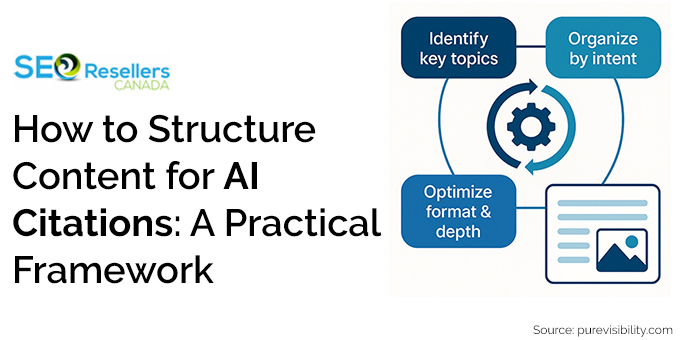
The following framework applies to any page where you want AI visibility, whether it is a blog post, service page, or resource guide.
4.1- Lead With the Answer, Then Explain It
Every section should open with a direct answer to the question your heading poses. This is the single most impactful structural change you can make.
Opening paragraphs that answer the query upfront get cited a lot more often. So, write the payoff first. Add context after.
Here is a structure you must follow-
- H2 or H3 heading that states the question or topic
- First 1 to 2 sentences must be direct and feature an extractable answer
- Following sentences should offer supporting detail, examples, or data
- A brief summary or key takeaway line (optional)
4.2- Use Heading Hierarchy and Lists Deliberately
AI engines parse content by breaking it into segments and mapping how ideas connect. Clear heading structures make this process easier. It even increases citation frequency.
So, focus on utilising –
- H2s for primary sections and H3s for subtopics within them
- Bullet points for lists of features, benefits, or steps
- Numbered lists for processes where order matters
- Tables when comparing options, tools, or data points side by side.
This is not formatting for aesthetics. It is formatting for machine readability, which is now a core part of white label SEO deliverables and on page SEO audits.
4.3- Include Original Data and Expert Perspectives

Pages that include original data tables earn 4.1 times more AI citations than those that do not, according to Princeton University research on GEO (Generative Engine Optimisation). Statistics in content improve citation performance by more than 5.5% compared to unoptimized versions of the same content.
If you have proprietary data, industry benchmarks, or expert quotes from your team, use them. AI engines cite sources that add something they cannot find anywhere else. Generic summaries of publicly available information rarely earn citations.
For SEO consulting teams, this is a strong argument for building proprietary research into your content calendar, even if it is just a quarterly client survey or a data pull from your own platform.
4.4- Implement FAQ and Schema Markup
FAQ sections are not just useful for readers. They are a proven AI citation trigger. Using FAQ schema on pages is a great way to increase the chances of those pages appearing in Google AI Overviews. The question and answer format fit well with the way language models work and extract information.
Proper Article and FAQ schema increases AI citations by 28%, according to Search Engine Land.
Priority schema types to implement include-
| Schema Type |
Why It Matters for AI |
| FAQ Schema |
Makes Q&A pairs extractable for AI Overviews |
| Article Markup |
Establish authorship, publish date, and content type |
| How-To Schema |
Structures step-by-step processes for clean extraction |
| Organisation Markup |
Builds brand authority signals across the knowledge graph |
4.5- Optimise for High Traffic Keywords Through Semantic Depth, Not Stuffing
Smart SEO keyword research now means identifying the full semantic cluster around a topic, not just the primary phrase. AI engines read for meaning, and not keyword frequency. A page that utilises a high-traffic keyword once but covers the topic thoroughly will outperform a page that employs the keyword twelve times with shallow coverage.
Map your primary keyword to its related entities, questions, and subtopics. Build content that genuinely addresses the full information need behind the query. This is how semantic SEO and AEO work in practice.
For example, if your main term is “content marketing SEO service,” the semantic cluster around it includes topical authority, content clustering, editorial strategy, and distribution. A page that interlinks these concepts gains more citation trust than a page that reiterates the core phrase.
4.6- Establish E-E-A-T Throughout Your Content
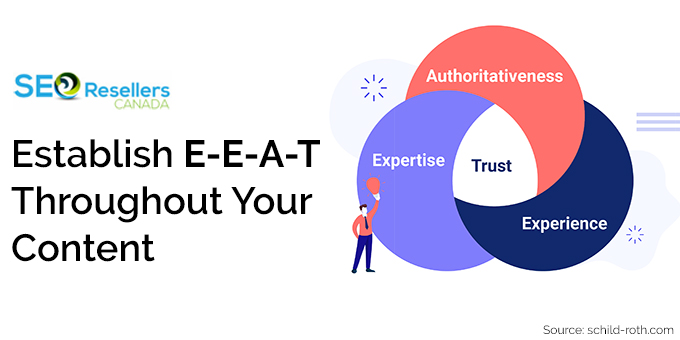
Google’s E-E-A-T framework (Experience, Expertise, Authoritativeness and Trustworthiness) is not just a ranking signal. It directly influences whether AI systems view your content as a citable source.
Practical steps include-
- Add author bios with relevant credentials to every piece of content.
- Cite and link to authoritative external sources, especially peer-reviewed research, and government data.
- Keep content updated. It is because pages updated within the last 30 days earn 3.2 times more AI citations than stale content.
- Build topical clusters that demonstrate consistent depth across a subject area.
This applies equally to SEO practices that produce client-facing content and to in-house marketing teams managing their own blogs.
5- Final thoughts
Getting cited in ChatGPT, Perplexity or Google AI Overviews is not luck. It is the direct result of structured content writing, disciplined on page SEO, and a deep understanding of how language models extract information.
Start with your highest-value pages. Lead with answers, build with structure and support every claim with credible data.
6- FAQs
6.1- What does it mean for an AI engine to "cite" content?
Tools like ChatGPT or Google’s AI Overviews surface answers directly from pages they have evaluated as credible as well as relevant. Getting cited means the AI trusts your content enough to put it in front of the user, which is increasingly where the real visibility lives.
6.2- Does on-page SEO still matter if I am targeting AI citations?
More than ever. Clear heading structure, schema markup, solid internal linking, and well-written copy- these aren’t legacy tactics. They are exactly what AI engines use to parse your pages and decide what’s worth pulling into a response. The overlap between traditional on-page SEO and AEO optimisation is significant, so teams that have done the foundational work are already ahead.
6.3- How does SEO keyword research change when you're optimising for AI search?
The shift is from chasing individual high-traffic keywords to building out semantic topic clusters. AI engines read for meaning and context. And keyword frequency isn’t enough to make that impact. Your SEO keyword research needs to map the full landscape around a topic: the questions people ask, the related entities, the surrounding concepts. The primary search term is just the starting point.
6.4- Can white label SEO providers help clients with AI citation optimisation?
Yes. White label SEO providers that have built fluency in GEO and AEO are well-placed to offer AI citation audits, content restructuring, and schema implementation as part of their existing packages. Clients are asking for it, and providers who move early have a real edge.